

Table of Contents
Lash clusters come in a much wider variety than their simple appearance might suggest. While they all share the basic structure of multiple lash fibers joined into small, wearable sections, cluster lashes can differ in their overall design, fiber arrangement, lash band construction, and adhesive system.
Terms such as wispy clusters, anime lashes, film band clusters, and pre-glued lashes are commonly used to describe different products. However, these names do not always refer to the same type of classification. Some describe the appearance of the lash fibers, while others identify the band structure or application system.
Understanding these distinctions makes it easier to recognize the different types of lash clusters available on the market and how manufacturers organize their product collections.
How Are Lash Clusters Classified?
There is no single universal classification system for DIY lash clusters. Instead, manufacturers and beauty brands typically describe them using several product characteristics.
For readers unfamiliar with the basic construction, understanding what cluster lashes are provides a useful starting point before exploring the different classifications.
The most useful classification methods include:
Product Format: How individual clusters are arranged, supplied, or organized into a product.
Lash Style: The visual design created by fiber length, layering, spacing, and arrangement.
Lash Band Design: The shape, construction, material, or color of the base connecting the lash fibers.
Adhesive System: Whether the clusters require separate lash adhesive or feature a pre-applied adhesive strip.
Lash Specifications: Characteristics such as fiber length, curl, and overall fullness.
These classifications are not mutually exclusive. For example, a product can be described as a wispy pre-glued cluster lash with a film band. Each term identifies a different aspect of the same product.
Other terms, such as cat eye or doll eye, generally describe lash mapping rather than a separate cluster structure. Understanding this distinction is especially important when comparing products or developing a lash collection.
Types of Lash Clusters by Product Format
One way to classify cluster lashes is by how the individual lash sections are presented and organized.
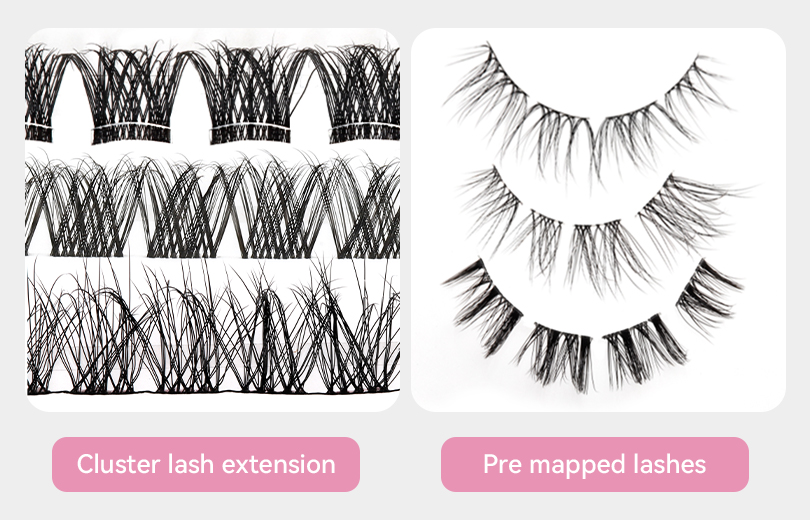
Individual Lash Clusters
Individual lash clusters are separate lash units, each containing a small group of fibers attached to a compact base.
They are typically supplied in trays containing multiple clusters, which may share the same design or include different fiber lengths. Because the units are separate, they can be arranged in different combinations during application.
Individual clusters form the foundation of many DIY lash collections, including natural, wispy, fluffy, and volume designs.
Pre-Mapped Lash Clusters
Pre-mapped lash clusters are products with a predetermined lash arrangement, usually designed around a particular length sequence or styling pattern.
Instead of leaving the entire arrangement to the user, manufacturers organize the clusters into coordinated sets. These may follow popular lash maps such as cat eye, doll eye, or other defined styling patterns.
Pre-mapped lashes are not a completely different fiber structure. They are a product format built around a planned arrangement of cluster units.
The distinction is therefore primarily about how the clusters are organized and presented, rather than how the individual lash fibers are manufactured.
Different Types of Lash Clusters by Style
Lash style is one of the most recognizable ways to distinguish cluster lashes. Unlike product format, which describes how clusters are supplied, style describes the visual characteristics of the lash fibers.
Common cluster lash styles include natural, wispy, fluffy, volume, spiky, and anime.
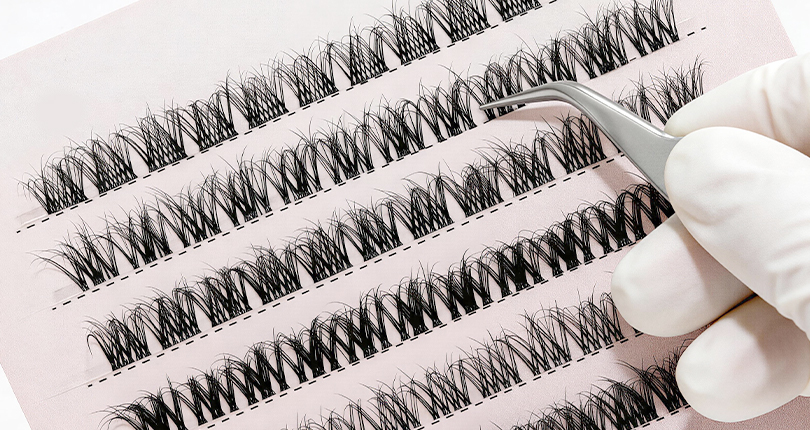
Natural Cluster Lashes
Natural cluster lashes are designed to create a soft, understated lash appearance.
They generally feature balanced fiber distribution, moderate fullness, and relatively subtle length variations.
Rather than emphasizing dramatic peaks or dense layering, the fibers are arranged to resemble naturally defined eyelashes.
Natural styles can vary in length and density, but their defining characteristic is a softer overall appearance.
Wispy Cluster Lashes
Wispy cluster lashes are characterized by alternating fiber lengths and a visibly layered structure.
Longer fibers extend beyond shorter surrounding fibers, creating an uneven yet coordinated silhouette. This variation gives wispy lashes their distinctive textured appearance.
Wispy designs can range from relatively natural to fuller, more dramatic styles. The term describes the arrangement of the fibers rather than a fixed level of density.
Fluffy Cluster Lashes
Fluffy cluster lashes emphasize a soft, airy, and dimensional appearance.
Their fibers are typically arranged to create visible layering and a feathered texture. Rather than appearing as a compact, solid lash section, the overall design has a more dispersed and lightweight visual character.
Fluffy styles may also be relatively full, demonstrating that softness and volume are not necessarily opposites.
Volume Cluster Lashes
Volume cluster lashes feature a fuller and more pronounced lash appearance.
They generally use greater fiber coverage, more layering, or a denser visual arrangement to create a stronger lash-line effect.
However, volume is not always a standardized numerical specification in the DIY cluster lash market. It is commonly used as a style description, and different manufacturers may offer different levels of fullness under the same name.
Spiky Cluster Lashes
Spiky cluster lashes feature clearly defined, pointed fiber sections that stand out from the surrounding lashes.
These prominent spikes create a structured appearance with noticeable variations in fiber length and concentration.
The defining characteristic is the visible formation of pointed lash groups rather than an evenly distributed lash silhouette.
Anime Cluster Lashes
Anime cluster lashes share the pronounced pointed sections found in spiky styles but introduce a more distinctive separation between them.
The key difference is the visible spacing or negative space between the spikes. These gaps make the pointed sections appear more isolated and prominent, creating a highly defined, stylized lash pattern.
While spiky lashes emphasize pointed fiber groups, anime lashes combine those groups with deliberate spacing to create a more exaggerated visual structure.
These style categories can overlap. For example, a cluster design may combine wispy layering with volume or incorporate spiky details into an otherwise natural-looking arrangement.
Types of Lash Clusters by Lash Band Design
The lash band is the base structure that holds the fibers together. Although it is a relatively small part of a cluster lash, its shape and construction provide another useful way to distinguish different products.
Lash bands can be classified by their shape, structure, material, and color.
By Lash Band Shape
Straight Lash Band
Straight-band clusters feature a base that follows a straight line. This is a common structural format used across many DIY cluster lash styles.
Curved Lash Band
Curved band cluster lashes feature a deliberately shaped base rather than a straight one.
Curved designs can be further distinguished by the direction of the curve:
Regular Curve: The center of the lash band curves inward, creating a concave shape.
Reverse Curve: The center curves outward, creating a convex shape.
These terms describe the geometry of the lash band itself, not the curl of the lash fibers.
Self-Curving Lash Band
Self-curving lash clusters feature a band that appears straight while attached to the production tray but automatically forms a curved shape when removed.
Unlike a conventional pre-shaped curved band, this category is defined by the band's ability to change shape after removal from the tray.
By Lash Band Structure and Material
Conventional and Superfine Lash Bands
Conventional lash bands use familiar fiber-joining structures, while superfine bands emphasize a particularly thin and discreet base.
The term superfine primarily describes the physical dimensions and appearance of the band rather than a specific material.
Film Lash Bands
Film band clusters feature an ultra-thin, flat base with a defined width. Unlike narrow, thread-like lash bands, the film base maintains a wider, flat surface while keeping the overall structure thin and lightweight.
Silicone Lash Bands
Silicone band clusters use silicone material as part of the lash base construction.
This makes silicone bands a material-based category, rather than simply a description of band thickness or shape.
It is worth noting that these categories describe different aspects of band design. For example, straight refers to shape, superfine refers to structure or dimensions, and silicone identifies a material.
By Lash Band Color
Cluster lash bands can also be classified by color, with black bands and clear bands being the most common options.
Black bands create a more defined lash-line appearance, while clear bands provide a less visible base for a softer, more seamless finish. Band color is an independent design characteristic and can be combined with different lash styles and band structures.
Types of Lash Clusters by Adhesive System
Another important distinction is whether lash clusters require a separate adhesive product or incorporate an adhesive system directly into the lash base.
Traditional Glue-On Lash Clusters
Traditional glue-on clusters are supplied without a ready-to-use adhesive strip.
They require a compatible lash adhesive or bonding product during application. The specific adhesive and application method depend on the intended DIY lash system.
These clusters are available in a wide range of styles, lengths, and lash band designs.
Pre-Glued or Press-On Lash Clusters
Pre-glued lash clusters, also known as press-on or self-adhesive clusters, feature an adhesive strip already attached to the lash base.
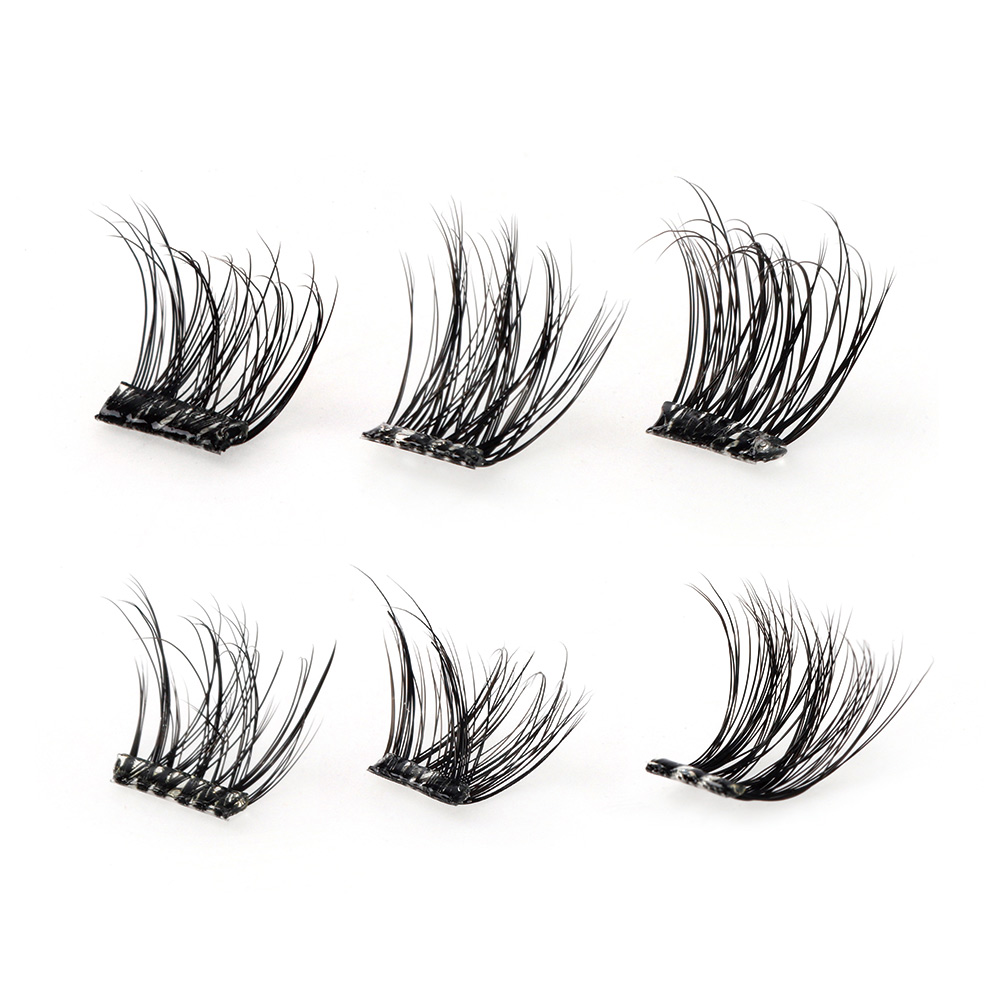
This allows the clusters to be positioned and pressed into place without applying separate liquid lash glue.
Pre-glued technology is an adhesive-system classification, not a separate lash style. Natural, wispy, fluffy, volume, and other cluster designs can all be developed with pre-applied adhesive systems.
Different adhesive formulations may also be designed for different wearing periods.
For a closer look at adhesive systems, application methods, and wear time, explore our guide to what pre-glued lashes are.
How Do Length, Curl, Volume, and Density Define Lash Clusters?
In addition to the main product categories, lash clusters are frequently described using specifications such as length, curl, volume, and density.
These characteristics help distinguish individual products within the same style or structure, but they do not necessarily represent separate product categories.
Lash Length
Lash length refers to the length of the individual lash fibers, usually measured in millimeters.
Many DIY cluster lash collections use an even-numbered length system, with 8 mm, 10 mm, 12 mm, 14 mm, and 16 mm being the most common options. In this context, an 8–16 mm range typically refers to these five lengths rather than every 1 mm increment within the range.
This differs from professional lash extensions, which commonly offer more detailed length increments, including odd-numbered sizes such as 9 mm, 11 mm, and 13 mm.
Single-length and mixed-length trays describe how these fiber lengths are packaged and combined, rather than separate types of lash fibers.
Lash Curl
Curl describes the degree of curvature in the lash fibers.
Unlike professional eyelash extensions, which are often categorized using clearly defined curl labels such as B, C, CC, D, and DD, DIY lash clusters are not always sold under the same detailed curl classification system.
Many DIY cluster lashes feature a naturally lifted curl, which may be visually comparable to a soft C-shaped curve.
For brands requiring a more pronounced or specialized curl, manufacturers can develop customized curl profiles according to the desired product design.
Lash Volume and Density
Volume and density are closely related descriptions of how full a cluster lash appears.
Volume generally refers to the overall fullness of the lash design, while density describes how closely the fibers are arranged.
In practice, these characteristics overlap, and many DIY cluster lash collections do not use separate numerical volume or density grades.
Instead, manufacturers commonly communicate differences in fullness through style categories such as Natural, Fluffy, and Volume.
For this reason, volume and density are best understood as descriptive product characteristics rather than universally standardized DIY cluster lash types.
Is Lash Mapping a Type of Lash Cluster?
Lash mapping is often mentioned alongside cluster lash styles, but it describes a different concept.
A lash map refers to the arrangement of clusters with different lengths, curls, or fullness levels to create a particular overall shape.
Popular examples include:
Cat Eye: Longer lash sections are concentrated toward the outer corner.
Doll Eye: Longer sections are generally positioned around the center.
Fox Eye: A more elongated arrangement that emphasizes the outer portion of the lash line.
Open Eye: A length distribution designed to create a more open, rounded appearance.
These names primarily describe styling arrangements rather than the structural types of the individual clusters.
For example, the same natural or wispy cluster design may be used to create different lash maps by changing the order and placement of the lengths.
The exception is pre-mapped lash clusters, where a particular arrangement has already been designed into the product set.
Therefore, lash mapping is better understood as an application and product-arrangement concept, rather than a primary classification of cluster lash construction.
How Can Brands Combine Different Lash Cluster Types?
Lash cluster classifications are not separate product categories that must be developed independently. Instead, different characteristics can be combined to create a wide variety of products within the same collection.
For example, a natural cluster lash may feature a superfine band and a traditional glue-on system, while a fluffy or anime design can be developed with a film base and pre-applied adhesive. The same lash style may also be offered in different lengths, band structures, or adhesive formats.
For beauty brands, understanding these classification dimensions makes it easier to organize product collections, identify variations within an existing range, and communicate customization requirements to manufacturers.
Rather than introducing entirely new styles for every product variation, brands can build a more structured collection by combining different lash formats, fiber designs, band types, and adhesive systems.
Frequently Asked Questions About Lash Cluster Types
What Are the Main Types of Lash Clusters?
Lash clusters are commonly classified by product format, fiber style, lash band design, and adhesive system. Product formats include individual and pre-mapped clusters; popular styles include natural, wispy, fluffy, volume, spiky, and anime; lash bands vary in shape, structure, and material; and adhesive systems are generally divided into traditional glue-on and pre-glued or press-on clusters. Length and curl provide additional product specifications.
Are Lash Cluster Styles and Lash Cluster Types the Same?
Not exactly. Lash styles describe the visual arrangement and appearance of the fibers, while lash cluster types can also refer to product formats, lash band structures, or adhesive systems. Natural, wispy, and volume are style descriptions, whereas pre-mapped, film band, and pre-glued refer to other product characteristics.
Are Pre-Glued Lashes a Separate Type of Lash Cluster?
Pre-glued lashes represent a different adhesive system rather than a separate fiber style. The same natural, wispy, fluffy, or volume cluster design can be manufactured with a traditional glue-on base or a pre-applied adhesive strip.
Are Cat Eye and Doll Eye Different Types of Lash Clusters?
Cat eye and doll eye primarily describe lash mapping arrangements rather than individual cluster structures. They refer to how different lash lengths are positioned to create a particular overall shape. However, these arrangements may also be offered as pre-mapped cluster lash products.
Are Lash Length and Curl Considered Different Cluster Lash Types?
Length and curl are product specifications rather than independent structural categories. Length describes the fiber measurement, while curl describes its curvature. Different lengths and curl profiles can be used across multiple cluster lash styles and band designs.
Can One Lash Cluster Belong to Multiple Categories?
Yes. Lash cluster classifications describe different characteristics of the same product. For example, a lash cluster can simultaneously be wispy in style, film-based in structure, and pre-glued in its adhesive system. These classifications can be combined rather than treated as mutually exclusive categories.
Conclusion
The different types of lash clusters are best understood through several connected classification methods.
Product format explains how clusters are organized. Lash style describes the arrangement and appearance of the fibers. Lash band design identifies differences in base shape and construction, while adhesive systems distinguish traditional glue-on products from pre-glued alternatives.
Length, curl, volume, and density provide additional product descriptions, while lash mapping explains how clusters can be arranged into different overall designs.
Understanding these distinctions helps beauty brands, distributors, and product developers compare cluster lash collections more accurately and recognize how different product characteristics can be combined.
Explore HIBEAUTY's wholesale cluster lashes or contact our team to discuss custom styles, lash band designs, pre-glued systems, and private label product development.
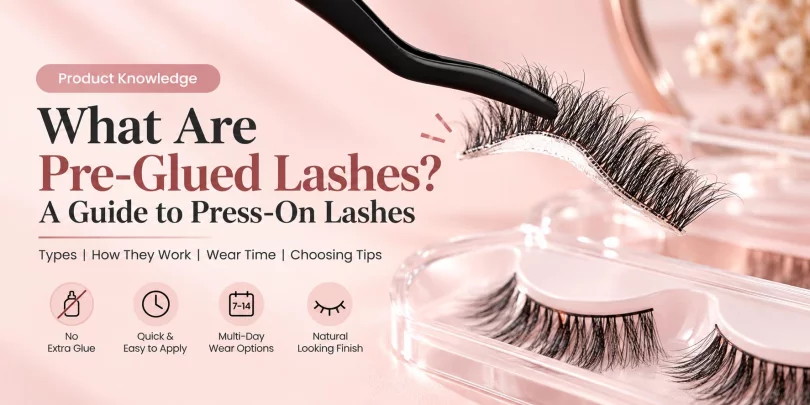
What Are Pre-Glued Lashes? A Guide to Press-On Lashes
Learn what pre-glued and press-on lashes are, how they work, different types, and how long they last. Explore lash styles, wear time, and key differences.
What Are Lash Clusters Made Of? A Manufacturer's Guide
What are lash clusters made of? Learn about PBT lash fibers, fiber processing, band and base materials, and how construction affects cluster lash quality.
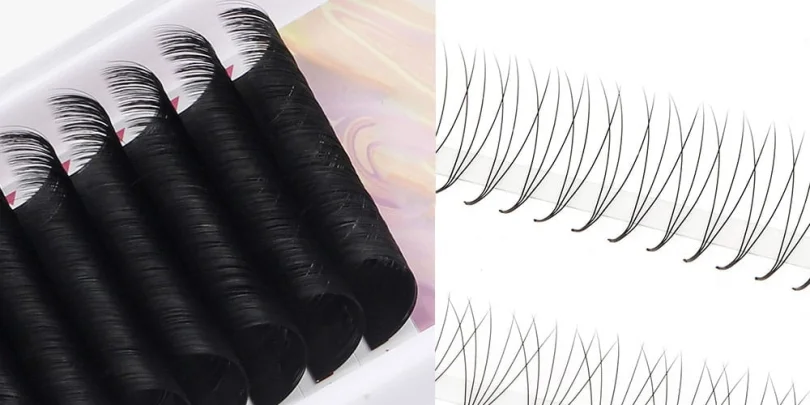
Handmade Fans vs Premade Fans: Which One Fits Your Lash Business?
Compare handmade fans vs premade fans in terms of cost, time, quality, and efficiency. Discover which option is best for your lash business and how to maximize profit.
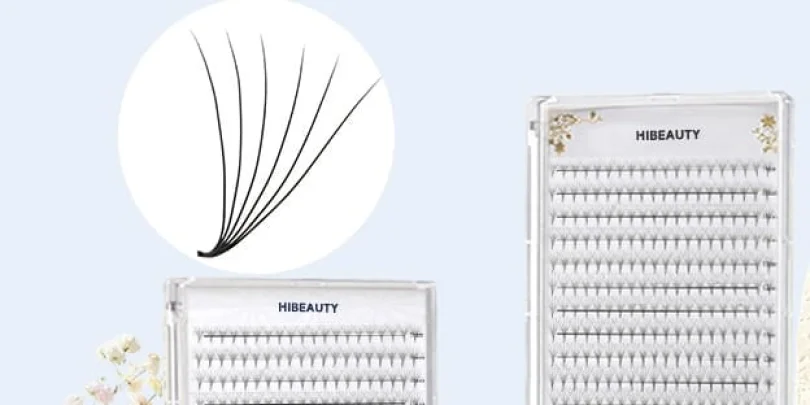
What Are Premade Fans? A Professional Guide to Premade Volume Fans for Lash Brands
What are premade volume fans? Get detailed info on materials, structure, types, advantages, and buying tips. Ideal for lash artists, salons, and wholesale lash brands.
Empowering Every Lash Brand: From Your First 100 Trays To Global Expansion.
-
 Scalable Production
Flexible volume support for every stage of your growth.
-
One-Stop Innovation
Bespoke lash engineering and free turnkey branding in one place.
-
Certified Excellence
100% manual QC and SGS/MSDS compliance for premium reliability.
-
Agile Supply
Rapid sampling paired with stable, long-term mass production.
-
Brand Partnership
We don't just supply products; we build your empire.



