

Table of Contents
Introduction
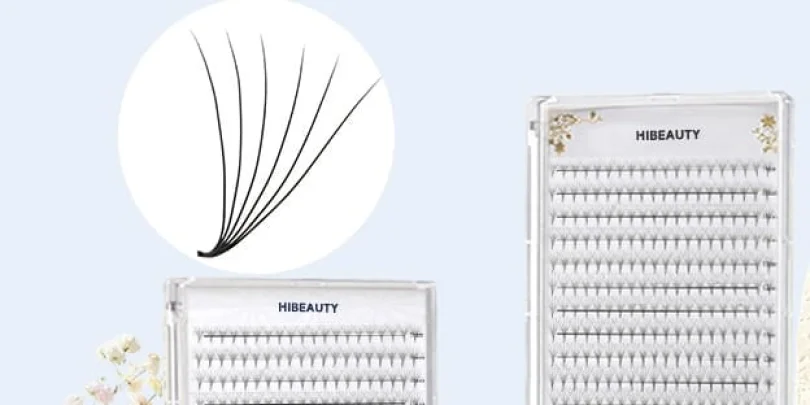
Most modern lash clusters are made from synthetic PBT (polybutylene terephthalate) fibers, which are processed, shaped, and assembled into small lash units with a band or base. While PBT forms the foundation of many cluster lash products, the finished lashes can vary significantly in softness, thickness, curl, surface finish, fiber shape, and overall appearance.
This is because what a lash cluster is made of involves more than its raw fiber material. PBT quality, fiber processing, fiber geometry, cluster formation, and band or base construction all contribute to the characteristics of the finished product. Even cluster lashes marketed as faux mink, silk, or other specialty fibers may share the same underlying PBT material while achieving different effects through processing and structural design.
From a manufacturing perspective, understanding these differences is more useful than simply asking whether a cluster lash is made from PBT. In this guide, we break down the fibers, band and base materials, manufacturing process, and structural details that determine how a lash cluster is actually made—and what lash brands should look for when evaluating different cluster lash products.
What Are Lash Clusters Made Of?
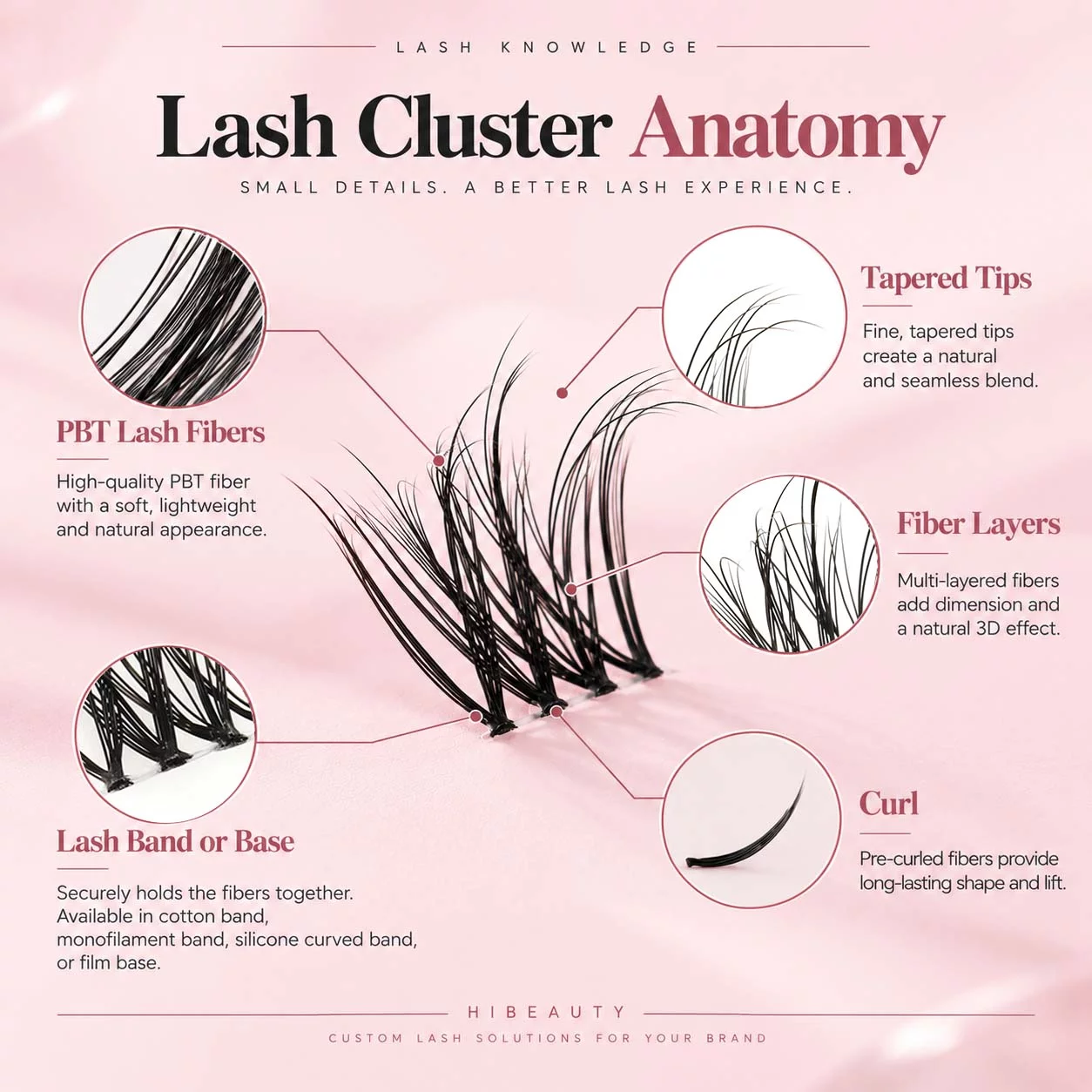
At the most basic level, a lash cluster is made from two main components: lash fibers and a band or base. Multiple lash fibers are arranged and secured together at the base to form one independent cluster unit.
The fiber determines much of the cluster's visible appearance, while the band or base holds the fibers together and provides the structural foundation of the cluster. Differences in both components can result in noticeably different finished products, even when two cluster lashes appear similar at first glance.
Lash Fibers
The lash fibers form the visible body of a cluster lash. Most modern cluster lashes use synthetic PBT fiber, which can be processed into different thicknesses, lengths, curls, tapers, finishes, and fiber shapes.
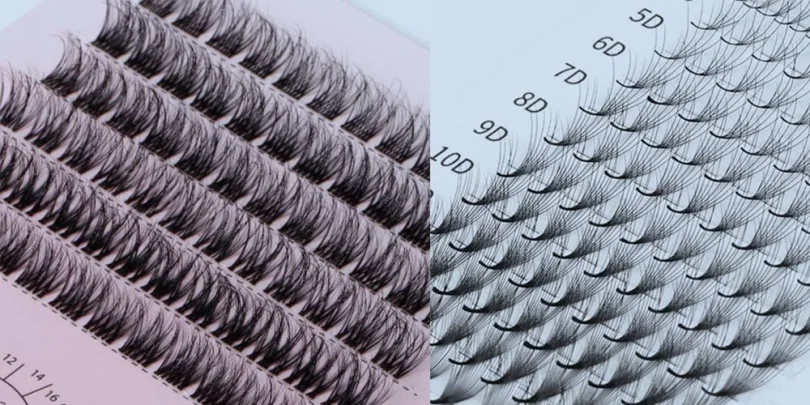
How the fibers are layered and arranged also affects the finished cluster. Changes in fiber distribution, density, and direction can create anything from a fine, natural-looking cluster to a fuller, more dimensional 3D effect.
This means that the material name alone does not fully describe the lash. Two products made from PBT can still look and feel very different because of differences in fiber quality, processing, geometry, and arrangement.
Lash Band and Base
The band or base is the part that secures multiple fibers together and allows them to function as a single cluster.
Cluster lash bases can be made using different materials and structures. Depending on the product design, these may include cotton bands, fine monofilament bands, silicone bands, or thin film bases.
The base is not simply a connection point. Its material, thickness, width, flexibility, curvature, and contact area can influence how securely the fibers remain together, how visible the base appears, how the cluster follows the lash line, and the overall wearing experience.
For this reason, understanding what lash clusters are made of requires looking at both sides of the product: the fibers that create the lash effect and the base structure that holds the cluster together.
What Materials Are Used for Cluster Lash Fibers?
PBT (polybutylene terephthalate) is the primary synthetic fiber used in most modern cluster lashes. It provides a versatile base material that can be processed into different thicknesses, curls, tapers, finishes, and fiber shapes.
However, simply knowing that a lash is made from PBT does not tell you everything about its quality or appearance. PBT fibers can vary in raw material quality and manufacturing consistency, while different processing methods can turn the same basic material into noticeably different finished lash fibers.
At HIBEAUTY, for example, we primarily use high-quality Korean PBT fiber for cluster lash production and further process the fiber according to the structure and effect required for each lash design.
Are “Mink,” “Silk,” and “Cashmere” Cluster Lashes Made From Different Materials?
Not necessarily. Names such as faux mink, silk, cashmere, and similar terms often describe the intended finish, texture, softness, or appearance of a synthetic lash rather than its literal raw material.
Many of these products are still based on PBT fiber.
Manufacturers can alter characteristics such as fiber thickness, taper, surface finish, softness, and arrangement through different processing methods. As a result, two cluster lashes made from the same underlying PBT material can have very different textures and visual effects.
This distinction is important when evaluating lash products: a marketing or collection name should not automatically be interpreted as the actual fiber composition.
How Can the Same PBT Fiber Create Different Lash Effects?
PBT is highly adaptable in lash manufacturing. Beyond changing thickness, taper, curl, and surface finish, manufacturers can modify the fiber through specialized processing or alter its physical geometry to create different product characteristics.
For example, bamboo charcoal fiber is a PBT-based fiber variation produced through a bamboo-charcoal impregnation process. The underlying synthetic fiber remains PBT-based, while the incorporation of bamboo charcoal gives the fiber its distinctive characteristics, including natural antibacterial properties. This allows manufacturers to introduce additional functional properties while retaining PBT as the fundamental fiber material.
Another example is triangle fiber. Instead of treating it as a different raw material, it is more accurately understood as PBT formed with a different fiber geometry. Its triangular cross-section changes the physical profile of the fiber and the way it reflects light, helping manufacturers create a different visual texture and finished lash effect.
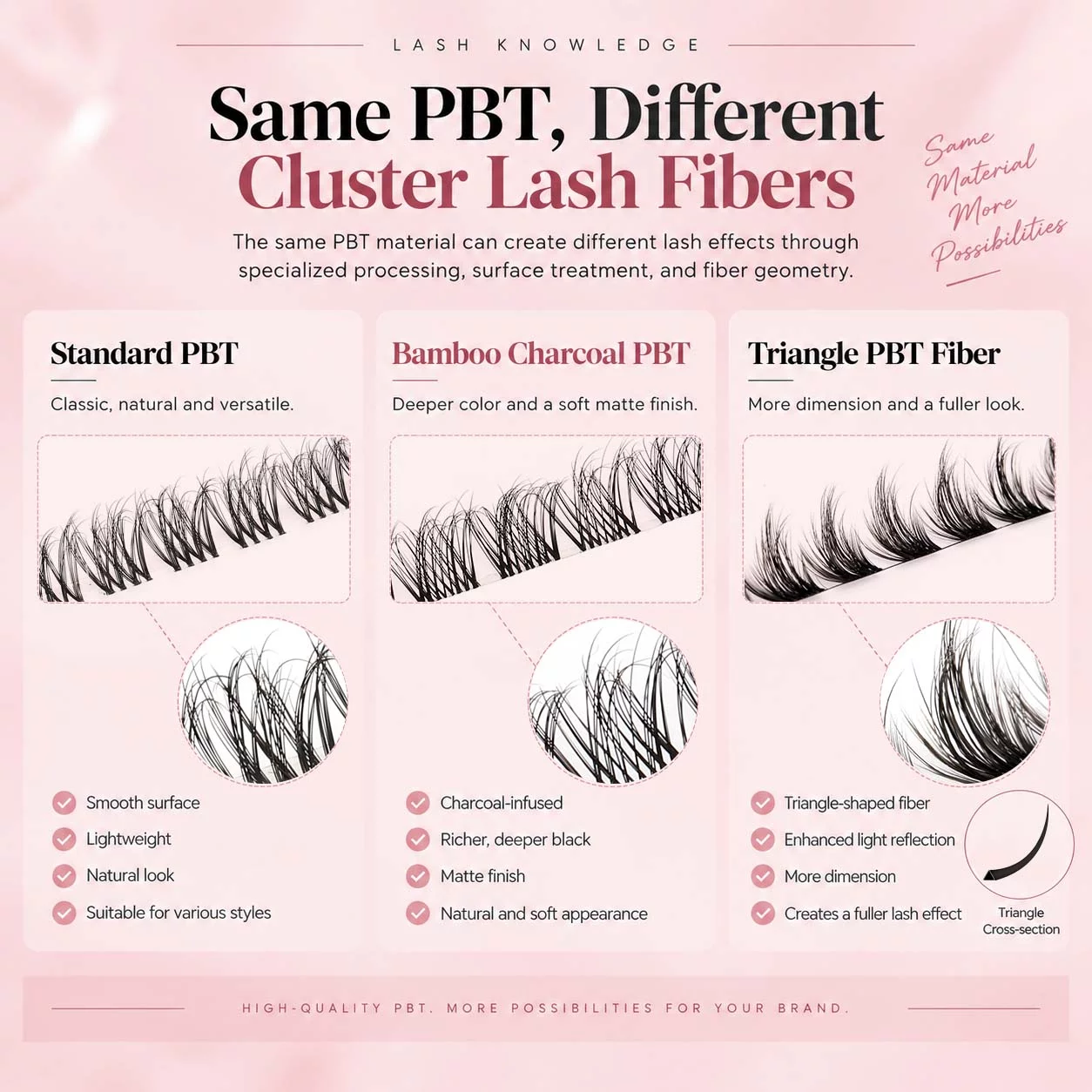
These examples illustrate an important principle in lash manufacturing:
Different lash effects do not always require different raw materials. The way PBT is processed, shaped, finished, and assembled can be just as important as the material itself.
Why Does PBT Fiber Quality Matter?
Although PBT is widely used across the lash industry, not all PBT fibers or finished lash products perform identically.
For cluster lash manufacturing, fiber quality and processing consistency can affect factors such as diameter uniformity, softness, surface consistency, curl formation, and curl retention. These differences become particularly important when the same product needs to be reproduced consistently across trays and production batches.
HIBEAUTY commonly produces cluster lashes at around 0.07 mm fiber thickness, with C curl being one of the most widely used options. Common lengths include 8, 10, 12, 14, and 16 mm, while D curl and other specifications can be developed according to product requirements.
Curl stability is also evaluated during product development. Under recommended cool and dry storage conditions, properly produced HIBEAUTY cluster lashes are designed to maintain their established curl for approximately one year.
For lash brands, this is why evaluating a cluster lash should go beyond asking, “Is it made from PBT?” The more useful questions are what quality of PBT is being used, how the fiber is processed, and whether the manufacturer can maintain the required characteristics consistently in production.
What Is the Band or Base of a Lash Cluster Made Of?
The band or base is the structural part that holds multiple lash fibers together as a single cluster. While it occupies only a small area of the finished lash, its material, thickness, flexibility, shape, and contact surface can significantly influence how the cluster performs and feels.
Base construction varies between cluster lash products. Cotton bands and fine monofilament bands are commonly used structures, while manufacturers can also develop specialized base designs to create different product characteristics. At HIBEAUTY, for example, we have developed Silicone Curved Band and Film Base structures to explore thinner, softer, and more contour-adapted cluster lash designs.
Cotton Band
A cotton band uses fine cotton-based material to create the connecting structure at the bottom of the cluster. It provides a defined base that keeps the arranged fibers together while maintaining enough flexibility for the cluster to function as an individual unit.
The thickness and construction of the cotton band can be adjusted according to the cluster design. A finer band can reduce its visual presence, while the overall construction must still provide sufficient stability to keep the fibers securely assembled.
Monofilament Band
A monofilament band uses a fine synthetic filament as the supporting structure across the base of the cluster. Compared with a more visible or textured band, the fine filament can create a cleaner and more discreet base appearance.
The diameter and flexibility of the filament are important because the band needs to remain fine while still providing enough structural support to hold the cluster together.
Silicone Curved Band
A silicone curved band introduces both a different material and a different structural approach. Instead of using a straight base, the soft silicone band is formed with a pre-designed curve that follows the natural contour of the lash line.
The combination of silicone flexibility and a curved profile allows the base to conform more naturally to the shape of the eye. This can improve the wearing experience while reducing the stiffness that may be noticeable with some conventional base structures.
For manufacturers, this is an example of how changing the base design—not just the lash fiber—can create a different cluster lash experience.
Film Base
Film bases use a thin, flexible film to connect and support the lash fibers. Their main advantage is that the base can be engineered to be very thin and lightweight while maintaining a sufficient contact area.
HIBEAUTY has developed both standard and Super Thin Film Base options as part of its cluster lash development. By reducing the thickness of the film, the base becomes less noticeable while retaining the structural support required to keep the cluster together.
The curved film structure is designed to follow the natural contour of the lash line, while its wider contact surface allows adhesive to distribute more evenly across the base. This can help create a more stable bond without relying on a thick or rigid band.
A thinner and softer edge can also improve comfort around areas such as the inner corner of the eye, where a thicker or stiffer base may be more noticeable against the skin.
This development illustrates an important point about cluster lash construction: the band or base is not simply what holds the fibers together. It can be engineered to influence flexibility, fit, contact area, visibility, and the overall wearing experience.
How Are Lash Fibers Turned Into a Cluster?
Turning lash fibers into finished clusters involves a controlled sequence of arranging, fixing, cutting, curling, and setting. While the exact process varies by cluster design, the basic manufacturing stages are similar.
1. Raw Material Inspection
Before production, the lash fibers are inspected for basic quality and consistency to ensure they are suitable for the intended cluster design.
2. Fiber Arrangement and Layering
The fibers are arranged and layered according to the required cluster structure. Their spacing, direction, and layering determine the density, dimension, and overall 3D appearance of the finished cluster.
3. Band/Base Fixing and Length Cutting
The arranged fibers are secured with the required band or base at the position corresponding to the intended lash length. Once the base is fixed, excess fibers are trimmed away to create the specified length and finished cluster shape.
4. Heat Curling
The clusters are heat-formed into the required curl. C curl is commonly used, while D curl and other curl types can be customized according to product requirements.
5. Cooling and Curl Setting
After heat forming, the clusters are removed and allowed to cool and continue setting in their formed shape. This helps stabilize the curl and contributes to long-term shape retention.
6. Tray Assembly
The finished clusters are arranged onto trays according to the product specification, whether in single lengths, mixed lengths, or other configurations, before final inspection and packaging.
Although PBT fiber provides the basic material, the finished cluster is shaped by the entire manufacturing process. Fiber arrangement, base construction, cutting accuracy, curl forming, and production consistency all contribute to the final product.
How Do Materials and Base Design Affect Cluster Lash Performance?
The performance of a cluster lash is determined by more than the fiber material alone. Fiber quality, processing, arrangement, and base design work together to influence how the finished cluster looks, feels, and maintains its shape.
| Product Element | How It Affects the Finished Cluster |
| Fiber Quality | Influences softness, uniformity, and overall consistency |
| Fiber Thickness & Taper | Affects visual density, weight, softness, and how natural the lash appears |
| Fiber Shape & Finish | Changes light reflection, texture, and the overall visual effect |
| Fiber Arrangement | Determines layering, dimension, density, and the natural appearance of the 3D effect |
| Curl & Curl Retention | Affects the lash shape and how consistently that shape is maintained during storage |
| Band/Base Material | Influences flexibility, stability, and the overall wearing experience |
| Base Thickness | Affects how noticeable the base is and how lightweight it feels |
| Base Curvature | Influences how naturally the cluster follows the contour of the lash line |
| Contact Surface | Affects how evenly adhesive can be distributed across the base |
These factors also need to work together. For example, an ultra-soft fiber does not automatically create a comfortable cluster if the base is too thick or rigid. Similarly, a thin base alone cannot compensate for inconsistent fiber arrangement or poor curl stability.
At HIBEAUTY, curl retention is evaluated as part of product performance testing. Under recommended cool and dry storage conditions, properly produced cluster lashes are designed to maintain their established curl for approximately one year.
For lash brands, this is why cluster quality should be evaluated as a complete structure rather than by fiber material alone. The combination of fiber, cluster construction, and base design ultimately determines the finished product experience.
What Should Lash Brands Look for When Choosing Cluster Lashes?
For lash brands, choosing a cluster lash should go beyond comparing fiber names or sample appearance. A reliable product needs to combine natural-looking construction, a secure base, stable curl, and consistent production quality.
Does the Cluster Create a Natural 3D Effect?
Look closely at how the fibers are layered and distributed. A well-constructed cluster should have balanced spacing, clear dimension, and a natural transition between different fiber layers rather than appearing flat or overly uniform.
What Type of Band or Base Is Used?
The base can directly affect flexibility, visibility, fit, and the wearing experience. Brands should understand whether a product uses a cotton band, monofilament band, or a specialized structure such as a silicone curved band or film base, and select the construction that fits the intended product positioning.
Is the Band or Base Secure?
The fibers should remain firmly connected to the base during normal handling. An unstable base can lead to fiber shedding, cluster separation, or inconsistent product performance.
Are the Curl and Shape Consistent?
Check whether the curl, length, layering, and overall cluster shape remain consistent across the tray. Curl stability is also important, particularly for products that may remain in inventory for an extended period before reaching the end customer.
Is the Quality Consistent Between Batches?
A good sample is only the starting point. For brands placing repeat or larger orders, batch-to-batch consistency is equally important. Fiber appearance, curl, cluster structure, base construction, and overall finish should remain consistent from one production run to another.
Can the Cluster Lash Be Customized?
Customization allows brands to develop products around their own market positioning rather than relying only on standard designs. Depending on the manufacturing capability, specifications such as fiber finish, thickness, length, curl, cluster structure, band/base design, lash mapping, and packaging can be adjusted for different product concepts.
For brands developing a long-term cluster lash line, the goal is not simply to find the “best material,” but to work with a manufacturer that can translate product requirements into a consistent, repeatable cluster lash design.
Frequently Asked Questions About Lash Cluster Materials
Are Cluster Lashes Made From Real Mink?
Most modern cluster lashes marketed as faux mink are made from synthetic fibers such as PBT rather than real mink hair. The term usually describes a soft, fine, mink-like appearance or finish rather than the actual raw material.
Are Cluster Lashes Made From Real Silk?
Usually not. In the modern lash industry, “silk lashes” commonly refers to a particular synthetic lash finish or product style, rather than lashes manufactured from natural silk. Many silk-style cluster lashes are still based on PBT fiber.
What Is PBT Fiber in Cluster Lashes?
PBT, or polybutylene terephthalate, is a synthetic polymer widely used to produce lash fibers. It can be processed into different thicknesses, tapers, curls, finishes, and fiber shapes, making it suitable for a wide variety of cluster lash designs.
Is Korean PBT Better for Cluster Lashes?
Korean PBT is widely used in professional lash manufacturing, but the origin of the fiber alone does not determine the quality of a finished cluster lash. Raw material quality, fiber processing, curl stability, cluster construction, and manufacturing consistency all need to be considered together.
HIBEAUTY uses high-quality Korean PBT fiber as the foundation for many of its cluster lash products, combined with different processing and structural designs according to the required product effect.
What Is the Best Material for Cluster Lashes?
There is no single material that is automatically best for every cluster lash. PBT provides the foundation for many high-quality products, but the finished result also depends on fiber quality, processing, geometry, arrangement, and band or base construction.
For brands, the better approach is to evaluate the complete product according to the intended lash effect, wearing experience, product positioning, and required production consistency.
Conclusion
So, what are lash clusters made of? In most modern products, PBT fiber forms the foundation, but the material name alone does not define the finished lash.
Fiber quality, specialized processing, fiber geometry, layering, curl formation, and band or base construction all contribute to how a cluster lash looks, feels, and performs. Even products made from the same basic PBT material can become very different cluster lashes through changes in fiber processing and structural design.
For lash brands, this means evaluating the complete product rather than the fiber name alone. A well-developed cluster lash should combine suitable materials with thoughtful construction and consistent manufacturing.
Develop Your Cluster Lash Collection with HIBEAUTY
HIBEAUTY develops cluster lashes using high-quality Korean PBT fiber, different fiber treatments and structures, and multiple band and base designs. From standard cluster specifications to customized fiber effects, curls, lengths, base structures, lash mapping, and packaging, we can develop products around different brand and market requirements.
→Explore HIBEAUTY Cluster Lashes
→Contact Us to Discuss Your Custom Cluster Lash Project
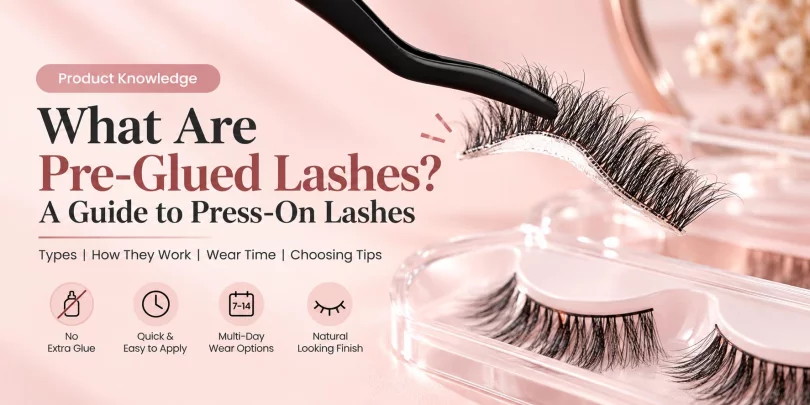
What Are Pre-Glued Lashes? A Guide to Press-On Lashes
Learn what pre-glued and press-on lashes are, how they work, different types, and how long they last. Explore lash styles, wear time, and key differences.
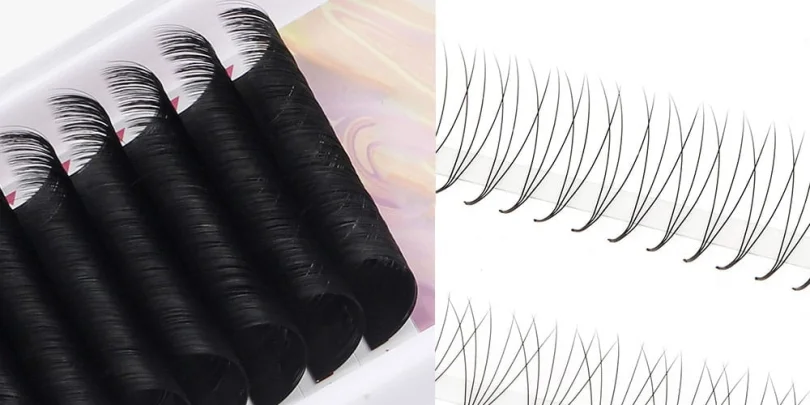
Handmade Fans vs Premade Fans: Which One Fits Your Lash Business?
Compare handmade fans vs premade fans in terms of cost, time, quality, and efficiency. Discover which option is best for your lash business and how to maximize profit.
What Are Premade Fans? A Professional Guide to Premade Volume Fans for Lash Brands
What are premade volume fans? Get detailed info on materials, structure, types, advantages, and buying tips. Ideal for lash artists, salons, and wholesale lash brands.
Cluster Lashes vs Individual Lashes vs Premade Fans – A Wholesale Lash Brand Perspective
What's the difference between lash extensions and clusters? Compare cluster lashes, individual lashes & premade fans. Learn structure, application, efficiency, cost & strategy for your lash brand.
Empowering Every Lash Brand: From Your First 100 Trays To Global Expansion.
-
 Scalable Production
Flexible volume support for every stage of your growth.
-
One-Stop Innovation
Bespoke lash engineering and free turnkey branding in one place.
-
Certified Excellence
100% manual QC and SGS/MSDS compliance for premium reliability.
-
Agile Supply
Rapid sampling paired with stable, long-term mass production.
-
Brand Partnership
We don't just supply products; we build your empire.



